I turned 40 and, apparently, my hair had some administrative changes it neglected to run by me first.
Not necessarily dramatic changes. Nothing worthy of a press conference.
Just enough little things to make me stand in the mirror on wash day wondering whether the hair products had changed, the weather had changed, I had changed—or my hair had simply decided we were entering a new era without consulting management.
Maybe your ponytail doesn’t feel quite as thick.
Maybe your scalp seems drier.
Maybe those gray hairs aren’t merely gray; they seem to have arrived with an entirely separate texture and their own opinions.
Maybe the routine you’ve been doing for twelve years suddenly isn’t giving what it used to give.
And if you start Googling, you quickly encounter two problems.
First, there is an enormous amount of information about “aging hair” that seems written for a woman with straight hair who owns one brush.
Second, a lot of articles talk about menopause as if every woman wakes up on her 40th birthday, her estrogen falls through the floor, and her hair immediately packs its belongings.
The actual science is more interesting.
So let’s talk about what can really happen to Black hair in your 40s—and what deserves a little more attention than simply buying another jar of something.
Disclosure: I may earn a commission from qualifying purchases made through Amazon links in this article, at no additional cost to you.
First: 40 Is Not a Hair Expiration Date
This needs to be said before we blame every rogue strand on aging.
There isn’t a switch inside your scalp labeled AGE 40: ACTIVATE DRYNESS.
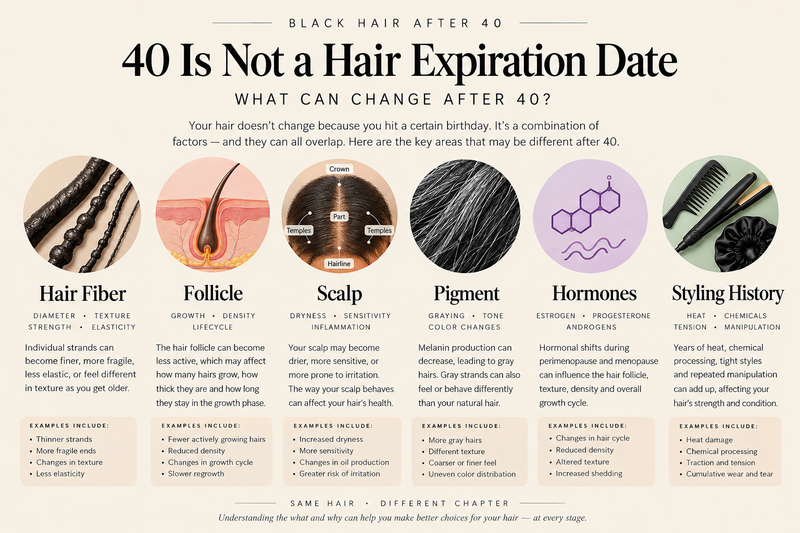
Hair changes gradually, and several things can overlap during this period of life.
Chronological aging is one.
Hormonal changes associated with perimenopause and menopause can be another.
Then there is genetics, graying, stress, nutrition, medications, health conditions, years of heat or chemical processing, protective styling, tension, and plain old cumulative wear and tear.
Researchers studying hair aging have documented changes in things including hair diameter, texture, growth and density as people get older. Menopause research also suggests that hormonal transition can affect the hair follicle, hair cycle, density, caliber and texture.
So yes, your hair may actually be changing.
But why it’s changing matters.
Because “I’m getting older” is an explanation.
It is not a diagnosis.
This was one of the first things that made me curious about aging hair.
Not necessarily bald spots.
Not necessarily handfuls of hair in the shower.
Just that subtle:
Was my ponytail always this small?
Hair density refers to how many hairs are growing within an area of your scalp. That is different from the thickness of each individual strand.
Both can affect how “full” your hair looks.
Research on hair aging suggests that density tends to decrease with age, while hormonal changes during the menopause transition may also influence characteristics such as hair caliber and growth. One study review found that changes in women’s hair parameters become particularly noticeable around the mid-40s.
Which is rude, but useful information.
There are several reasons your hair might look or feel less dense:
- fewer actively growing hairs
- finer individual strands
- increased shedding
- breakage
- female-pattern hair loss
- traction-related hair loss
- scarring forms of alopecia
- simply having less volume than you had ten years ago
And with Black hair, separating hair loss from breakage is especially important.
Afro-textured hair has structural characteristics that can make the fiber more susceptible to mechanical breakage, and dermatology literature identifies breakage, traction alopecia and central centrifugal cicatricial alopecia among important concerns in women of African descent.
So if you’re trying to preserve the hair you have, this is a good stage of life to get serious about reducing unnecessary manipulation.
That can mean gentler detangling, less tension and paying attention to whether the styles you once wore comfortably are suddenly making your scalp feel like it has filed a complaint.
For wash day, I keep a running list of detangling brushes, wide-tooth combs, deep conditioners and other Black hair products I use or would consider.
But if your actual density is changing, no detangling brush on God’s green internet can diagnose why.
We’ll come back to that.
Sometimes the problem isn’t that you have dramatically less hair.
Your hair simply doesn’t feel like the hair you remember.
Researchers have found that aging can affect hair fiber diameter, texture and other characteristics of the hair produced by the follicle.
Hormonal transition may contribute as well. A recent review of menopause and hair loss describes potential decreases in density and caliber along with changes in hair texture during this stage of life.
Translation:
You are not necessarily imagining it if your hair feels different.
And that matters enormously for natural hair because our routines are often built around very specific assumptions about our strands.
You may have spent years knowing:
My hair likes this much water.
This leave-in works under this gel.
This section always needs more conditioner.
Protein and I are currently not speaking.
Then suddenly the formula stops formula-ing.
A product that once gave you beautiful definition leaves your hair stiff.
A butter that used to disappear into your strands now seems to be sitting upstairs waiting for somebody to invite it in.
Your usual wash-and-go doesn’t look quite the same.
That doesn’t automatically mean your curl “type” changed.
It may mean some of the properties influencing how your hair behaves have changed.
And when that happens, I’m much more interested in reassessing the routine than buying fourteen products because TikTok told me my hair needs rosemary, cloves, fenugreek, batana oil and a minor exorcism.
If you’re experimenting carefully, I’ve collected moisturizers, leave-ins, gels, mousses and other products designed with Black hair in mind here.
One variable at a time, ladies.
We are doing research.
This one gets complicated.
People often say that hair simply “gets dry with age.”
There is some biology underneath that idea, but I wouldn’t reduce every dry twist-out after 40 to hormones.
Estrogen affects both hair follicles and sebaceous glands, and estrogen deficiency after menopause is associated with increased skin dryness. Research into menopausal changes also describes altered hair quality and structure.
That makes hormonal change a reasonable part of the conversation.
But Black hair already has a complicated relationship with lubrication.
The curves and bends of tightly curled hair make it more difficult for scalp sebum to travel down the full length of the strand compared with straighter hair. Add chemical processing, heat, weather, manipulation and increasingly gray strands to the situation, and “my hair is drier now” can have more than one contributor.
This is why blindly adding oil isn’t always the answer.
Oil can reduce friction and help slow moisture loss.
Oil is not water.
I repeat because somewhere a jar of coconut oil just got nervous:
Oil is not water.
If my hair were suddenly feeling drier, I’d look at the entire routine:
Is my cleanser too stripping?
Am I conditioning long enough?
Do I need more water during styling?
Has my styling product changed?
Am I using more heat?
Am I clarifying enough—or too much?
Am I actually experiencing product buildup and interpreting it as dryness?
Has my scalp changed too?
Those questions tell you much more than automatically reaching for the heaviest butter available.
For the product side of that experiment, I’ve grouped deep conditioners, moisturizing leave-ins, oils, creams and wash-day products for textured hair here.
We spend a lot of time discussing our hair as though it floats independently above our heads.
Meanwhile, the scalp is downstairs handling operations.
Hair follicles exist within skin, and aging and hormonal changes affect the skin environment too. Estrogen interacts with hair follicles and sebaceous glands, while menopause-associated estrogen decline has been linked with increased skin dryness and other changes in skin physiology.
So if you’ve noticed that your scalp:
- feels drier
- becomes irritated more easily
- flakes differently
- reacts to products it once tolerated
- feels tight or tender
don’t automatically assume that the solution is more grease.
There is a difference between a dry scalp, seborrheic dermatitis, contact dermatitis, psoriasis and inflammatory conditions associated with some types of hair loss.
This matters particularly for Black women because certain alopecias deserve early attention.
Central centrifugal cicatricial alopecia—CCCA—is a progressive form of scarring hair loss seen disproportionately in Black women. It often begins near the crown or center of the scalp, and once follicles are permanently scarred, the hair loss can become irreversible.
Which brings me to something I’m going to repeat throughout this site:
A tender, burning, itchy or progressively thinning crown is not something I would spend six months treating with oils before seeing a dermatologist.
Especially not because somebody online told you your follicles needed peppermint.
Your follicles may need a doctor.
Some women get a few cooperative silver strands that blend gracefully into their hair.
And some of us get grays that stand straight up in the middle of the hairstyle like they have been called to testify.
Gray hair happens when follicles produce less melanin and eventually stop producing pigment.
But color isn’t necessarily the only thing you may notice.
Hair aging research describes changes in diameter, texture and luster over time, meaning the gray hairs entering your routine may not behave exactly like the pigmented hairs beside them.
This creates an especially interesting situation with Black hair.
You might have:
- dark strands
- silver strands
- finer strands
- coarser-feeling strands
- multiple curl patterns
- chemically colored strands
all occupying the same head.
That means the old idea of finding one perfect product for your hair type becomes increasingly ridiculous.
Your head may contain multiple neighborhoods.
They do not all have the same zoning laws.
If your grays are particularly dry or unruly, a good moisturizing conditioner, leave-in or styling cream for textured hair can help with manageability.
But I’ll be doing an entire separate deep dive into gray Black hair because the science deserves more attention than:
Gray hair is coarse. Use conditioner.
I have questions.
This is where things get especially interesting.
Aging and hormonal changes can influence hair caliber, growth and texture.
And when the physical characteristics of your strands change, your overall curl pattern can appear different too.
That doesn’t necessarily mean you’ve gone from 4A to 3C because you entered perimenopause.
Hair typing is not a laboratory blood test.
Your visible pattern can be affected by:
- strand diameter
- length
- density
- damage
- chemical treatments
- heat
- hydration
- gray percentage
- styling technique
- hormones and aging
So if the curls around your temples have loosened while your crown has become tighter—or your wash-and-go suddenly has sections behaving like distant cousins rather than siblings—there may be several explanations.
This is another area where I’m far more interested in documenting what changed than immediately forcing your hair into a new typing category.
Take pictures.
Watch the same sections over several months.
Pay attention to shedding.
Notice whether the change is occurring at the root or primarily along older lengths.
Then adjust what your hair actually needs.
For styling while you’re figuring it out, my textured-hair product list includes gels, mousses, creams and curl-defining products.
These words get used interchangeably online.
They shouldn’t.
Shedding
The entire strand releases from the follicle as part of the hair cycle.
Breakage
The strand snaps somewhere along its length.
Thinning
Your overall hair coverage or density is decreasing, which can happen for multiple reasons.
Why does the distinction matter?
Because putting a strengthening conditioner on hair loss originating at the follicle is like fixing a flat tire by washing the car.
It may make something prettier.
It did not solve the problem.
Midlife hair loss can include conditions such as female-pattern hair loss and telogen effluvium. Reviews of menopausal hair changes also describe reduced scalp density and changes in hair growth.
Black women also need to keep traction alopecia and CCCA on the radar. Dermatology literature identifies both as particularly relevant forms of alopecia in women of African descent.
If the issue truly is breakage, then reducing mechanical stress matters.
Things like a satin bonnet or pillowcase, gentle detangling tools and moisturizing conditioners can make a sensible routine more breakage-conscious.
But if your part is widening or your scalp is becoming increasingly visible, I’m not going to tell you that you just need a better bonnet.
That’s when we investigate.
At some point we have to discuss the hairstyles we have been asking our follicles to survive since 1997.
Braids.
Ponytails.
Slick-backs.
Extensions.
Wigs.
Loc styles.
Buns.
They aren’t inherently bad.
But tension is tension.
Traction alopecia develops when repeated pulling places chronic stress on follicles. It is particularly relevant in Black women because some common styling practices can create sustained tension. Early traction alopecia can be reversible, while prolonged disease may eventually become scarring.
This does not mean you turn 40 and braids become illegal.
It means the hairstyle that felt fine ten years ago deserves reconsideration if your edges are now noticeably thinner.
Listen to your scalp.
Pain is not the price of admission.
A headache is not how you know the braids are secure.
And “they’ll loosen in three days” is perhaps one of the greatest lies ever passed between Black women.
Gentler accessories can help reduce unnecessary tension—I keep satin scrunchies, edge-friendly accessories, bonnets and other low-manipulation hair tools here—but styling changes matter more than buying another accessory.
Every follicle cycles through periods of active growth, transition, rest and shedding.
Hair aging involves changes not just to the strand we see but to the follicle producing it. Reviews have documented age-associated changes in hair growth, follicle behavior and the surrounding scalp environment.
Hormonal changes may influence that system too.
Hair follicles respond to estrogen, and menopause research continues to explore how decreasing estrogen and relative androgen changes affect women’s scalp hair.
What I do not want us to conclude is:
My estrogen must be low, therefore I should take X supplement.
Hair shedding has a long list of possible causes.
Hormonal changes are one category.
So are illness, major stress, rapid weight change, nutrient deficiencies, thyroid disorders, medications and various dermatologic conditions.
This is where the internet becomes dangerous because it can turn:
“Several things could cause this.”
into:
“Take biotin.”
Very quickly.
Of everything on this list, this may be the least scientific-sounding and the most useful.
The routine that worked beautifully at 32 does not have to remain your routine at 42.
That is not failure.
Your hair is biological material.
It changes.
Your lifestyle changes.
Your environment changes.
Your gray percentage changes.
Your styling preferences change.
Your tolerance for spending five hours twisting 73 sections of hair on Sunday evening may definitely change.
And honestly?
That last one deserves its own study.
If your hair is behaving differently now, rebuild your routine around what is happening today.
Not around what used to work.
Start simple:
Cleanse.
Condition.
Detangle gently.
Add moisture.
Style.
Protect.
Observe.
You don’t need twelve products.
You need enough consistency to tell what is actually working.
If you’re rebuilding your routine, I’ve put the Black hair products, wash-day essentials and styling tools I’m considering or recommending in one Amazon collection so you don’t have to go wandering through 400 pages of products.
I don’t want every Black woman over 40 blaming every hair change on menopause.
That is too easy.
And sometimes too dangerous.
Hair loss in Black women can involve conditions that benefit from early diagnosis.
CCCA deserves particular attention because it is a scarring alopecia that disproportionately affects women of African descent and may progress if untreated.
See a dermatologist—ideally one experienced with textured hair and hair-loss disorders—if you’re noticing things such as:
- rapidly increasing hair loss
- a widening part
- progressive thinning at the crown
- smooth or shiny areas where follicles appear absent
- burning or tenderness
- persistent scalp pain
- significant itching
- patches of hair loss
- substantial unexplained shedding
Do not spend a year trying seventeen oils first.
Please.
Amazon Prime cannot biopsy your scalp.
Potentially quite a bit.
But not all at once.
And not identically for every woman.
You may notice changes in:
Density.
Your hair may gradually feel less full.
Strand thickness.
Individual hairs can become finer or otherwise change in diameter.
Texture.
The hair coming from your follicles may not behave exactly as it once did.
Moisture and manageability.
Changes in the scalp, hair fiber, gray percentage and hormone environment may influence how your hair feels and responds to products.
Pigment.
Gray strands bring their own visual—and sometimes textural—changes.
Growth and shedding.
The hair cycle can change with age, hormones, health and other factors.
Scalp behavior.
Dryness, irritation or other scalp symptoms may become more noticeable.
And then there are the things that aren’t “aging” at all but become easier to notice with time: accumulated damage, chronic tension and hair-loss conditions that deserve medical attention.
There are thousands of articles explaining 4C hair.
Thousands explaining porosity.
Thousands telling Black women to sleep in a bonnet.
Fine.
I own several.
What I don’t see nearly enough of is serious discussion about what happens when the Black woman who has been caring for her textured hair for decades suddenly realizes:
Something changed.
Not:
“How do I learn my hair?”
We already learned it.
We have spreadsheets.
We have product graveyards underneath the bathroom sink.
We remember the SheaMoisture formulations from before the reformulations.
The question now is:
Why is the hair I’ve known for years suddenly behaving differently?
That’s what I’m interested in investigating.
So this article is the beginning.
Next we’re going deeper into thinning, dryness, changing texture, gray hair, scalp changes, curl patterns, perimenopause, menopause, shedding and the extremely personal betrayal of discovering that the product you bought repeatedly for eight years suddenly does absolutely nothing.
Because Black hair after 40 isn’t simply “older hair.”
It is hair entering another biological chapter.
And I would like to know what the hell is going on.
Preferably with citations.
This article is for educational purposes and is not a substitute for diagnosis or medical care from a qualified healthcare professional.
Amazon disclosure: As an Amazon Associate, I may earn from qualifying purchases made through links in this article, at no additional cost to you.