Overview
The growing recognition of the connections between health and democracy is a testament to both the long-term public health work of improving upstream determinants of health and the work of many others to realize the democratic promises of the Constitution. Building on a six-year partnership, the Network and Health & Democracy Partners are launching the Health & Democracy Peer Group, a collaborative space for representatives of community-based organizations, health departments, and healthcare organizations interested in building trust in government and public health so they work for the people.
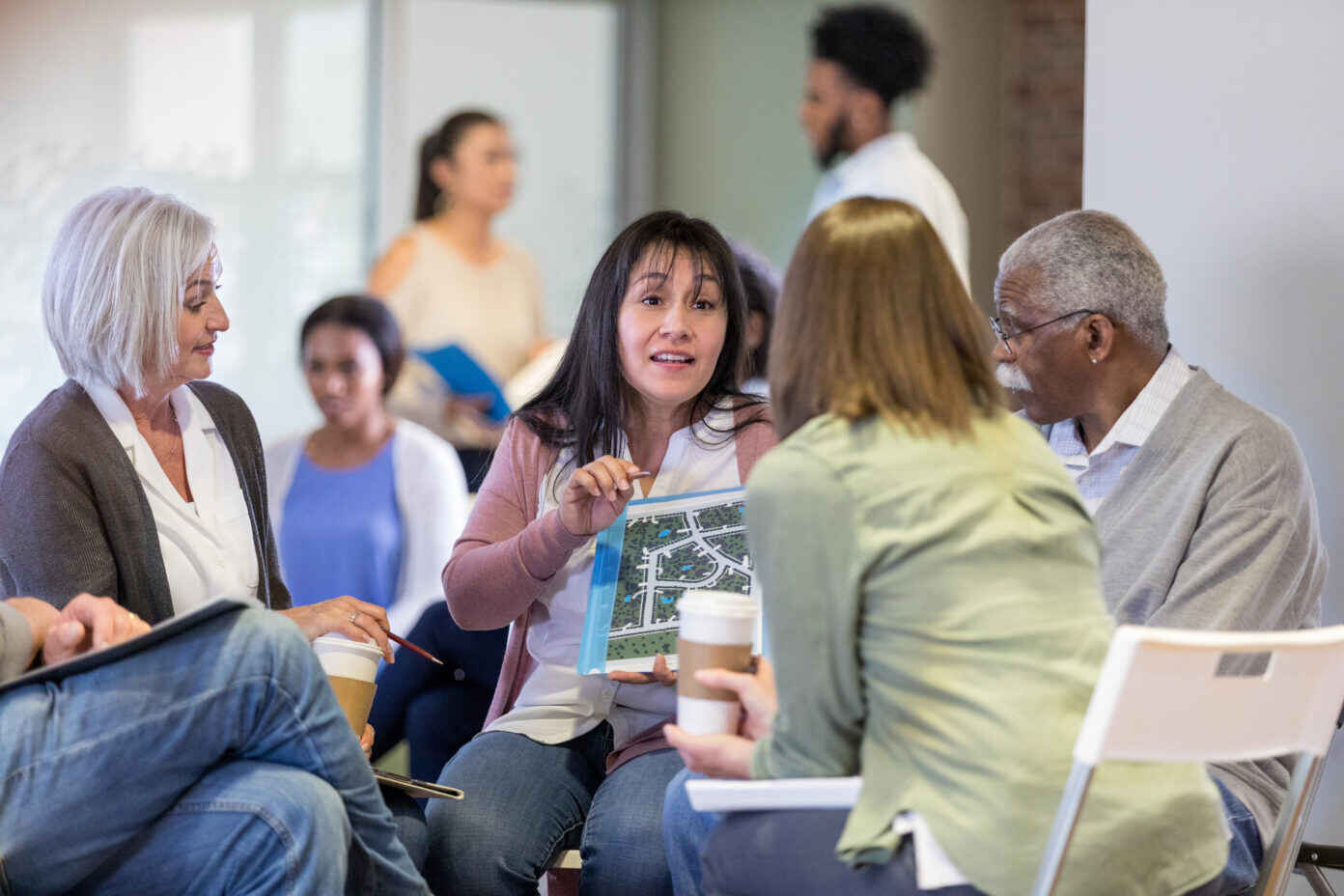
At a 2009 city council meeting about how tax-increment financing dollars should be spent, I presented the public health case for allocating funding to sidewalks near an under-resourced and predominantly Spanish-speaking mobile home park. I did this on behalf of a community coalition the local health department I worked at was supporting. Among public testimony that came mostly from developers, city council members were most moved by the data on how nonexistent sidewalks along the shoulders of a state highway trapped families at home and stories demonstrating the safety hazard posed to children especially who were trying to reach school or city bus stops or access vital health and community services. While that testimony contributed to the formal classification of the mobile home park area as a high-priority infrastructure gap, continued civic engagement from the community was necessary to ensure physical construction of a safer, more active living corridor many years later.
I didn’t fully realize it at the time, but that series of civic engagement activities, especially over time, was foundational public health work. It was one upstream component of a multifaceted initiative to address increasing rates of obesity, cancer, and other health problems that also included midstream and downstream components like free recreation center access and home visits and other direct service referrals that could also be seen as civic engagement. The initiative met the community where they were, addressed their priorities, and was an important trust link between public health, the healthcare partner who carried on the backbone work of the coalition when the initial government grant ended, and the community they sought to serve.
I also didn’t think of that health initiative as civic engagement or democracy-strengthening work at the time, equating only the act of voting at the ballot box as synonymous with civic engagement. Reflecting now, though, I see public health work is—or should be—fundamentally civic engagement work, too. Why? Because health and democracy are interdependent, and the growing recognition of the connections between the two is a testament to both the long-term public health work of improving upstream determinants of health and the work of many others to realize the democratic promises of the Constitution.
Similarly, the practice of public health law is transdisciplinary in nature; it is “what lawyers, public health researchers, policy advocates, community mobilizers, and others do together to research, develop, advocate for, and implement evidence-based legal interventions to prevent disease and reduce injuries.” This includes facilitating law and policy pathways to civic engagement to advance health equity, which has led to a suite of related resources created by the Network for Public Health Law (Network), enabling us to be a trust link between public health and communities.
Building on a six-year partnership, the Network and Health & Democracy Partners are launching the Health & Democracy Peer Group, a collaborative space for representatives of community-based organizations, health departments, and healthcare organizations interested in building trust in government and public health so they work for the people. With the help of members interested in co-designing the space, the Health & Democracy Peer Group aims to develop and empower health and democracy leaders through peer support, resource sharing, learning sessions, and practice opportunities.
As one example of the learning sessions the Health & Democracy Peer Group can offer, the Network is hosting an open webinar on August 27 about voting rights and public health with the Southern Poverty Law Center and Health & Democracy Partners. The Southern Poverty Law Center will unpack what the U.S. Supreme Court decision in Louisiana v. Callais and other recent legal developments mean for voting rights, the public’s health, and public health. Speakers will also discuss what public health can do to protect voter power and otherwise increase civic engagement to build trust with community and improve both health outcomes and health systems. Attend the upcoming Public Health in Pursuit of Voting Rights for All webinar to learn more, or in the future, through the Health & Democracy Peer Group.
This post was written by Darlene Huang Briggs, J.D., M.P.H., Deputy Director, Special Projects, Network for Public Health Law.
The Network promotes public health and health equity through non-partisan educational resources and technical assistance. Materials provided are solely for educational purposes, do not constitute legal advice nor create an attorney-client relationship with you or any other person, and are subject to the Network’s Disclaimer.
Support for the Network is provided by the Robert Wood Johnson Foundation (RWJF). The views expressed in this post do not represent the views of (and should not be attributed to) RWJF.